Are you a current Dormer customer? Sign up for Online Access
Are you a new customer? Sign Up for a Dormer Account

Need Help? Contact us or visit the How-To Videos here.
Are you a current Dormer customer? Sign up for Online Access
Are you a new customer? Sign Up for a Dormer Account
Need Help? Contact us or visit the How-To Videos here.
Please check your Email to verify your request and follow the instructions to create a new password.
Continue
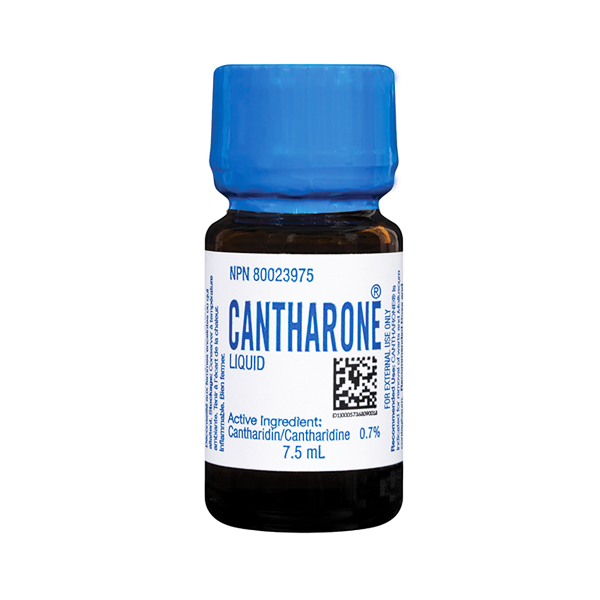
Product ID:9001-975M
Important
To be applied by a Licensed Health Care Practitioner only. Due to its toxicity and potential for misuse, CANTHARONE® is not recommended for dispensing or prescribing to patients. Poisonous, may be fatal if ingested. For external use only.
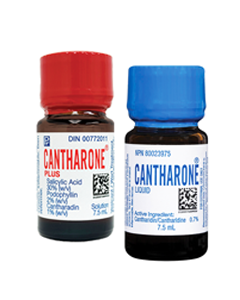
Cantharone Liquid and Cantharone Plus are manufactured in Canada in conformance with Good Manufacturing Practices (GMP). Cantharone Liquid is registered with Health Canada under Natural Product Number 80023975. Cantharone Plus is registered with Health Canada under Drug Identification Number 00772011. For Licensed Health Care Practitioner use only.
- Simple office procedure, no special instrument required
- A selective procedure not randomly destructive
- Painless application
- Produces a uniform blistering action
- Leaves no permanent scars
CANTHARONE LIQUID, cantharidin collodion is a topical liquid containing 0.7% cantharidin in a film-forming vehicle containing acetone, collodion, castor oil and camphor. The active ingredient, cantharidin, is a vesicant. The chemical name is: Hexahydro-3a, 7a-dimethyl-4b,7b-epoxyisobenzofuran-1,3-dione (C10H12 O4).
CANTHARONE LIQUID is indicated for removal of common warts, molluscum contagiosum and periungal warts. It is designed for topical application by a licensed healthcare professional only. Painless application and the absence of instruments makes it especially useful for treating children (some pain may occur later).
The vesicant action of cantharidin is the result of its primary acantholytic action. Its effectiveness against warts is presumed to result from the “exfoliation” of the tumor as a consequence of its acantholytic action. There are no reports of scarring when cantharidin is used alone as directed, presumably because the lytic action of cantharidin does not go beyond the epidermal cells. The basal layer remains intact and there is minimal effect on the corneum.
BEFORE USING, PLEASE REVIEW THE WARNING AND CAUTION INFORMATION IN THE PACKAGE
TREATING WITH CANTHARONE LIQUID
Molluscum contagiosum: On the first visit, treat only a few lesions until the sensitivity of the patients is known, then multiple areas can be treated in one visit. Using a pointed wooden stick, apply a very small amount of solution to only the top of each lesion. Let dry completely. No occlusive tape or dressing is needed (but may be used). Alert patient that blistering is the desired result and that temporary hypopigmentation may occur. The patient may bathe after 4 to 6 hours; sooner if discomfort occurs. Blisters are usually formed by about 24 hours, and crust up in about four days. Mild discomfort or itching can usually be controlled with bathing and night time sedation. In one week, treat any new lesions the same way and retreat any resistant lesions with CANTHARONE LIQUID, this time recovering with a small piece of non-porous plastic tape. The tape should be removed in 4 to 6 hours or sooner if discomfort occurs.
Common and periungal warts: No cutting or prior treatment is required (occasionally nails must be trimmed to expose subungual warts to medication). Using a pointed applicator stick, apply CANTHARONE® directly to the lesion; be sure to cover the growth completely, extending beyond by about 1 mm. Allow a few minutes for a thin membrane to form and cover with a piece of non-porous plastic adhesive tape, e.g. Blenderm®. (taping with occlusive tape is important for full activity). Instruct patient to remove tape in 24 hours and replace with a loose Band-Aid®. On next visit, (1 or 2 weeks), remove necrotic tissue and re-apply CANTHARONE® to any growth remaining. A single application may suffice for normally keratinized skin.
PLANTAR WARTS: Prior to the treatment, thoroughly clean the surrounding skin to assure good adhesion of the occlusive tape. Proper taping with non-porous plastic tape is an important part of the procedure. Pare away keratin covering the wart; avoid cutting viable tissue. Using a pointed applicator stick, apply CANTHARONE® to both the wart and about 1 to 3 mm margin around the wart. Allow a few minutes to dry. Secure with a non-porous plastic adhesive tape directly on the treatment site. A doughnut pad over the tape may be helpful. Then secure everything in place using additional tape. After 24 hours, the patient may bathe and replace the dressing. Debride one to two weeks after the treatment. If any viable wart tissue remains after debridement, re-apply a small amount of CANTHARONE® and bandage as above. Three or more such treatments may be required for large lesions. For large mosaic warts, treat a portion of the wart at a time. Applying CANTHARONE LIQUID to open tissue will result in stinging from the solvent. This can usually be avoided if paring is done carefully and treatments are two weeks apart. When destruction of the wart is complete, the healed site will appear smooth, with normal skin lines.
CANTHARONE LIQUID AND CANTHARONE PLUS
- Both products are very potent, use sparingly. Treatment is at 10 days to 2 week intervals. Delay treatment if inflamed.
- Both products are to be used under occlusion with a non-porous tape, e.g. Blenderm®, occlude no longer than 8 hours with CANTHARONE PLUS and 24 hours with CANTHARONE LIQUID
- Note: Tape is not normally used when treating molluscum
- Sterile puncture of the blister will help relieve discomfort and should be done at the discretion of the licensed health care practitioner.
- Daily soaks are at the discretion of the licensed health care practitioner. It is recommended to use a mild anti-bacterial soap until tissue re-epithelializes.
- Store at room temperature. Keep away from heat. Flammable.